What makes Egyptian cotton superior to regular cotton?
What Makes Egyptian Cotton Superior to Regular Cotton?
Ask most people what they know about Egyptian cotton and they'll tell you it's expensive and luxurious. Ask them why, and the answer is usually less certain. "It's softer" is the most common response - which is true, but only scratches the surface of a more interesting and more technically grounded story. Egyptian cotton's superiority over regular cotton is not a marketing invention. It is rooted in plant biology, agricultural geography, and the physics of textile production - and understanding it properly helps explain why the investment is worth making.

It Starts With the Plant
All cotton - Egyptian, American, Indian, Chinese - comes from plants of the genus Gossypium. But not all Gossypium species are created equal, and the difference between the species used for regular cotton and the one used for genuine Egyptian cotton is the foundation of everything that follows.
Regular cotton - the cotton used in the overwhelming majority of everyday textiles worldwide - comes primarily from Gossypium hirsutum, sometimes called upland cotton. It is a robust, highly productive plant that grows across a wide range of climates and conditions, which is precisely why it dominates global cotton production. Its fibres are typically between 25 and 28mm in length - adequate for producing perfectly serviceable textiles, but not long enough for the finest spinning.
Egyptian cotton comes from Gossypium barbadense - a different species entirely, cultivated in the Nile Delta under conditions that have no real equivalent elsewhere in the world. The rich alluvial soil of the delta, deposited over millennia by the Nile, the warm, sunny climate, the low humidity, and the mineral composition of the irrigation water combine to produce cotton fibres of exceptional length - typically between 34 and 45mm, with the finest extra-long staple varieties reaching beyond that. These are not marginal differences. At the finest end of the spectrum, an Egyptian cotton fibre is nearly twice the length of a standard upland cotton fibre, and that difference drives every quality attribute that follows.
Why Fibre Length Changes Everything
The length of a cotton fibre - its "staple length" in textile industry terminology - determines what can be done with it during spinning, and how the resulting yarn behaves in the finished fabric.
Spinning into finer yarn. Longer fibres can be twisted together into a finer, more even yarn. Shorter fibres, with less length to work with, produce a thicker, less uniform yarn with more protruding fibre ends on its surface. This is not a small manufacturing detail - it determines the entire character of the finished fabric.
Surface smoothness. Those protruding fibre ends on short-staple yarn are what give regular cotton its characteristic slightly rough, matte texture. They are also what causes pilling - as the protruding ends catch, clump, and ball up with repeated use and washing. In long-staple Egyptian cotton, the fibres lie smoothly along the length of the yarn with fewer protrusions, producing a fabric surface that is genuinely smooth to the touch and resistant to pilling over time.
Strength and durability. Longer fibres mean more contact between fibres along the length of the yarn, which translates directly into greater tensile strength. Egyptian cotton yarn is stronger than regular cotton yarn of comparable weight. This is why Egyptian cotton bedding maintains its quality through years of regular washing while standard cotton bedding degrades - the underlying structure is simply stronger.
Lustre. The smooth, flat surface of long-staple Egyptian cotton reflects light more evenly than the rougher surface of short-staple cotton, producing the subtle natural sheen associated with quality linen. This is particularly evident in sateen-woven Egyptian cotton, where the surface floats of the weave maximise this reflective quality.
The Weave - How Egyptian Cotton's Potential is Realised
Egyptian cotton's superior fibre quality creates the potential for exceptional fabric. The weave determines how that potential is realised.
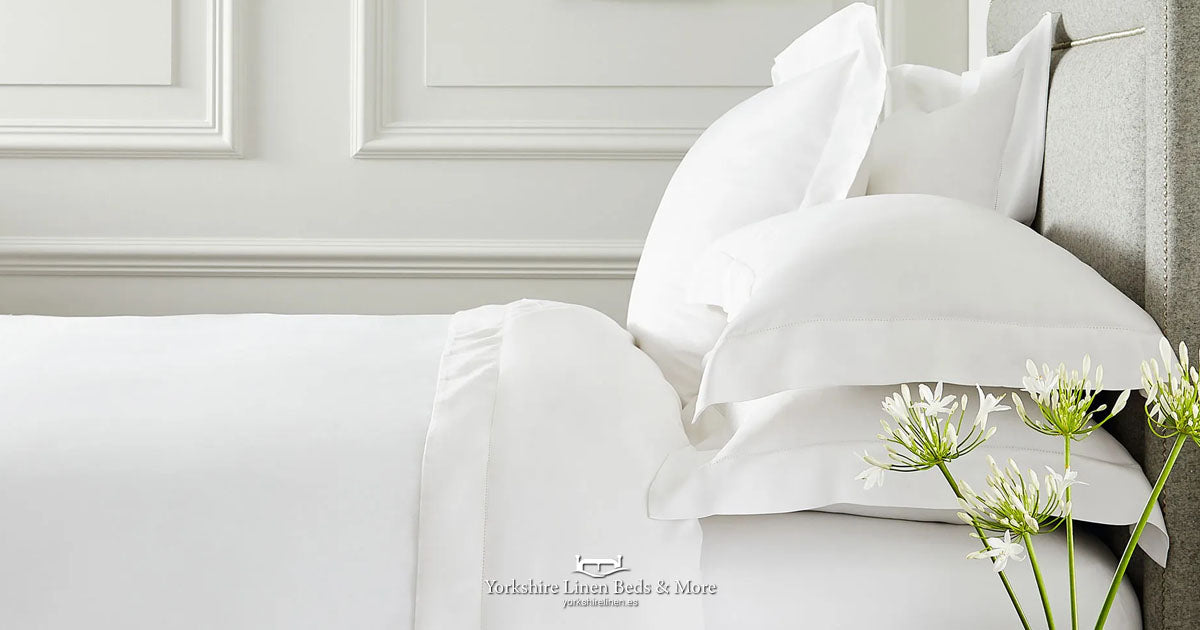
Sateen weave - in which four threads pass over one before passing under - creates a fabric with a long surface float, maximising the smoothness and lustre of the Egyptian cotton fibre. The result is the cool, silky surface feel and subtle sheen that characterise the finest hotel bedding. Sateen is the weave most associated with luxury Egyptian cotton bed linen.
Percale weave - the alternating one-over-one structure - produces a crisper, more matte fabric with a slightly cooler feel against the skin. In Egyptian cotton, percale has a refinement and crispness that regular cotton percale cannot match - the long fibres produce a fabric that feels clean and fresh in a way that is immediately perceptible.
Regular cotton is most commonly found in plain weave equivalents to percale. While perfectly functional, the shorter fibres mean the fabric has a slightly rougher texture and less lustre, and it does not hold up to repeated washing as well as Egyptian cotton in either weave.
The Improvement Over Time - Egyptian Cotton's Most Remarkable Quality
Perhaps the most counterintuitive quality of genuine long-staple Egyptian cotton is that it improves with washing rather than deteriorating.
With each wash cycle, the yarn structure relaxes slightly, the surface smooths further, and the fabric becomes progressively softer and more lustrous. The sheen deepens. The drape becomes more fluid. The feel against the skin becomes gentler. This improvement continues over many wash cycles before eventually plateauing at a quality that remains consistently above what it was when new.
Regular cotton - and polycotton blends - go in exactly the opposite direction. Early wash cycles may soften them somewhat, but the shorter fibres begin to pill and the surface roughens with repeated washing, as the protruding fibre ends catch and clump. The fabric looks tired, feels less comfortable, and loses the fresh quality it had when new. This degradation is gradual enough that most people don't consciously notice it - but compare a well-washed set of regular cotton bedding with a new set, and the difference is immediately apparent.
This means that a set of Egyptian cotton bedding at year five is in some respects better than it was at year one - which is a genuinely unusual claim for any product to be able to make honestly.
Breathability and Temperature Regulation
Egyptian cotton's long, fine fibres produce a fabric that is naturally more breathable than regular cotton at comparable thread counts. The finer yarn creates a more open structure within the weave - even at high thread counts - that allows air to circulate more freely through the fabric.
In practical terms, this means Egyptian cotton bedding is more effective at drawing perspiration away from the skin, dissipating body heat, and maintaining a comfortable sleep temperature through the night. In warm climates - and for people who sleep hot - this is a meaningful and measurable benefit. Spain's long, warm summers make it particularly relevant: the difference between waking up in a damp, uncomfortable tangle of synthetic or low-quality bedding and waking up in cool, dry Egyptian cotton is experienced directly, every night, for five or six months of the year.
The Value Equation - Is It Actually Worth It?
The honest answer, for most buyers, is yes - provided you are buying genuine certified Egyptian cotton and not a mislabelled imitation.
The higher initial cost of Egyptian cotton bedding is offset over time by its longevity and improving quality. A set of 540TC or 600TC Egyptian cotton bedding that lasts five or more years with weekly washing, and improves throughout its life, represents better value than multiple sets of standard cotton bedding purchased over the same period - even before accounting for the night-to-night quality difference.
For those who have never experienced genuine high-thread-count Egyptian cotton bedding, the first night is usually the moment of conversion. The cool smoothness against the skin, the weight and drape of the fabric, the way it maintains its quality through the night rather than bunching and twisting - it changes what you expect of bedding, and makes it very difficult to go back.
Shop Egyptian Cotton Bedding at Yorkshire Linen
Yorkshire Linen Beds & More stocks two exceptional Egyptian cotton ranges, both available online and in our Mijas showroom.
Free delivery throughout mainland Spain and Portugal on orders over €65. Visit us at Ctra. de Mijas, Km 3.5 - Monday to Friday 10am–6pm, Saturday 10am–5pm. Phone: +34 952 197 577. WhatsApp: +34 626 147 703.
Yorkshire Linen Beds & More - Quality Home Textiles on the Costa del Sol since 2005.