What is the difference between Egyptian cotton and regular cotton?
If you've spent any time shopping for bed linen, you'll have noticed that "Egyptian cotton" commands a significant premium over standard cotton. The marketing around it is lavish - words like "luxury", "silky", "hotel-quality", and "exceptional softness" appear on almost every label. But what actually is the difference between Egyptian cotton and regular cotton? Is it genuinely worth the extra cost, or is it largely a marketing story? The answer is more interesting - and more grounded in real science and geography - than most people expect.
What is the Difference Between Egyptian Cotton and Regular Cotton?

It Begins With the Plant and Where It Grows
All cotton comes from the same genus of plant, Gossypium - but different species and varieties are cultivated in different parts of the world, and the conditions in which cotton grows have a profound effect on the characteristics of the fibre it produces.
Egyptian cotton comes specifically from Gossypium barbadense, a long-staple variety cultivated in the Nile Delta region of Egypt. The conditions here are extraordinary: rich, alluvial soil deposited over millennia by the Nile, a warm and sunny climate, low humidity, and the particular mineral composition of Egyptian river water used for irrigation. This combination of factors produces cotton plants whose fibres grow significantly longer, finer, and more uniform than those of the standard short-staple varieties - primarily Gossypium hirsutum - grown across most of the rest of the world, including the United States, India, China, and Pakistan.
Regular cotton - the cotton in the vast majority of everyday bedding, clothing, and home textiles - is typically Gossypium hirsutum. It is a robust, productive plant that grows well across a wide range of climates and soils. The fibres it produces are shorter - typically between 25 and 28mm in length - and slightly coarser. It is excellent cotton, entirely capable of producing comfortable, durable textiles. But it is a different material to Egyptian cotton in ways that matter considerably when the end product is bed linen.
The Fibre Length Difference - Why It Matters So Much
The central technical difference between Egyptian cotton and regular cotton is fibre length - what the textile industry calls "staple length". Egyptian cotton fibres typically measure between 34 and 45mm in length, compared to the 25–28mm of standard short-staple cotton. Some of the finest Egyptian cotton - the extra-long staple varieties used in the highest quality bed linen - reaches lengths of 45mm or beyond.
 |
 |
This difference in length cascades through every subsequent stage of textile production and determines almost everything about how the finished fabric looks, feels, and performs.
Spinning: Longer fibres can be spun into a finer, more uniform yarn. Shorter fibres produce a yarn that is slightly thicker and less even, with more protruding fibre ends on the surface.
- Surface texture: Those protruding fibre ends are what creates the slightly rough, matte quality of regular cotton fabric - and what causes pilling over time as they catch and clump together. Egyptian cotton's longer fibres lie smoother along the yarn, producing a finer, cleaner surface with fewer protruding ends - which means less pilling, more smoothness, and that characteristic subtle sheen.
- Strength: Longer fibres mean more inter-fibre contact along the length of the yarn, which translates directly into greater tensile strength. Egyptian cotton yarn is stronger than regular cotton yarn of equivalent weight. This is why Egyptian cotton bedding lasts longer and maintains its quality through more wash cycles.
- Thread count: Because Egyptian cotton can be spun into a finer yarn, more threads can be woven into a given area of fabric - which is why genuinely high thread counts (400, 600, even higher) are achievable in Egyptian cotton without the fabric becoming unpleasantly heavy or stiff. The same thread counts in regular short-staple cotton produce a denser, heavier fabric that can feel thick rather than fine.
The Weave - Sateen vs Percale
Egyptian cotton bedding is commonly available in two weave structures - sateen and percale - and understanding the difference between them helps explain why Egyptian cotton linen can feel so different between products even at the same thread count.
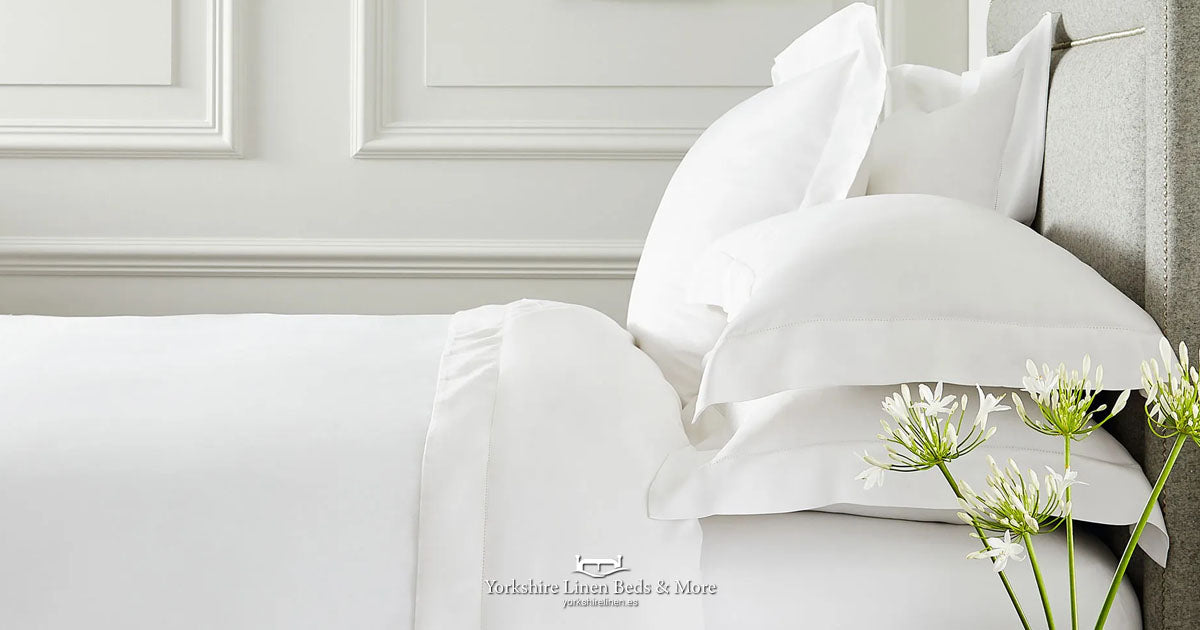
Sateen is a weave in which four threads pass over one thread before passing under, creating a long surface float that produces a smooth, lustrous finish. Sateen Egyptian cotton has that characteristic silky feel and subtle sheen - it reflects light gently and has a slight weight and drape that feels immediately luxurious. The 600 thread count range at Yorkshire Linen is woven in sateen.
 |
 |
Percale uses a simple one-over-one alternating weave, which produces a crisper, more matte fabric with a slightly cooler feel against the skin. Percale is particularly popular in warm climates - the firmer, more open weave allows slightly better airflow than sateen. Both are excellent; the choice comes down to personal preference for feel and finish.
Regular cotton bedding is more commonly found in percale-equivalent plain weaves, as the shorter fibre doesn't lend itself as readily to the long surface floats of sateen.
How Does Regular Cotton Compare in Practice?
This is the honest part of the comparison. Regular cotton - good quality short-staple cotton, properly woven - is a perfectly comfortable, practical bedding material. It is breathable, washable, durable at moderate price points, and entirely fit for purpose in most households. Polycotton blends (cotton mixed with polyester) reduce the cost further still and offer practical advantages in terms of reduced ironing and faster drying.
For rental properties that require frequent, high-temperature laundering and rapid turnover, a good quality polycotton or plain cotton at 180–200 thread count is often the most practical choice - not because Egyptian cotton can't be washed frequently (it can), but because the economics of high-volume rental laundry favour a lower per-unit cost.
Where regular cotton falls short of Egyptian cotton is in the accumulation of small differences that add up to a substantially different daily experience: the slight roughness that becomes more pronounced after repeated washing, the tendency to pill, the absence of that cool, smooth, skin-kind quality that Egyptian cotton delivers consistently and that actually improves over time.
Does Egyptian Cotton Really Get Better With Washing?
Yes - and this is one of the most counterintuitive and genuinely pleasing qualities of long-staple Egyptian cotton. With each wash, the structure of the yarn relaxes slightly and the surface of the fabric becomes progressively smoother and softer. The sheen deepens. The drape improves.
Regular cotton goes in the other direction: early wash cycles may soften it somewhat, but over time the shorter fibres pill, the surface roughens, and the fabric loses whatever freshness it had when new. A regular cotton duvet cover at the end of its life is noticeably inferior to the same cover when new. A 600TC Egyptian cotton duvet cover at the end of its life - which may be five or more years after purchase, with weekly washing throughout - is softer and more beautiful than it was on the first night.
This is not a small difference. Over a five-year ownership period, a set of Egyptian cotton bedding that improves with use represents considerably better value than cheaper bedding that deteriorates - even accounting for the higher initial outlay.
A Word on Labelling - and Why It Matters
The Egyptian cotton market has a labelling problem that is worth understanding before you buy. Because "Egyptian cotton" commands a premium, the term has been widely misused - applied to products that contain only a small percentage of genuine Egyptian cotton, or that use the term loosely to imply a quality association without the substance behind it.
Genuine Egyptian cotton bedding should carry certification from the Cotton Egypt Association - the independent body that audits and verifies the entire supply chain from field to finished product. This certification is the only reliable guarantee that the product you're buying contains authentic, long-staple Egyptian cotton from the Nile Delta region.
The 600 thread count Egyptian cotton range at Yorkshire Linen Beds & More carries this certification - which is why we're confident in describing it in the terms we do. It is not a marketing story. It is a verifiable, audited quality standard, and it is what separates genuine Egyptian cotton from the imitations.
The Bottom Line
Regular cotton is good. Egyptian cotton - genuine, certified, long-staple Egyptian cotton at a proper thread count - is in a different category. The difference is not primarily one of marketing; it is one of fibre biology, agricultural geography, and textile engineering. You feel it the first night. You appreciate it more every subsequent night. And unlike almost every other household purchase, it gets better rather than worse as time goes on.
For those on the Costa del Sol who spend much of the year sleeping in temperatures that make bedding quality directly felt rather than merely aesthetically appreciated, Egyptian cotton is not an indulgence. It is the sensible choice.
👉 Shop the Egyptian Cotton Range at Yorkshire Linen Beds & More.
Visit us in store at Ctra. de Mijas, Km 3.5, Mijas, Monday to Friday 10am to 6pm, Saturday 10am to 5pm. Phone: +34 952 197 577. WhatsApp: +34 626 147 703.
Yorkshire Linen Beds & More - Quality Home Textiles on the Costa del Sol since 2005.